
Saturday, April 23
Walking with Jackie
Jackie is becoming an expert on the difference between ground and pavement, and the implications they have for sleeping. Frankly, Jackie is my hero. When the idea of a street retreat was presented during the first Community Outreach meeting, her response was candid: "I'm terrified. I'm not young like the rest of you and I'm diabetic, so sleeping on the streets scares me. But these kids mean so much to me, I'll do it."
She is very conscientious, and every week or so she would have some concern about being a burden on the group and suggest that maybe she shouldn't go. I would tell her she was free to not come, but I insisted she was no trouble. Each time she would look at me discerningly, trying to detect insincerity. But I meant it every time, and every time she would say, "Ok, well, I'm glad. I really want to go, but I don't want to be trouble."
I'm glad she believed me, because her presence is invaluable. Not only is she wonderful and wise, she is more willing to participate and more enthusiastic than many of the younger counterparts. She is motivated by an aunt-like love for the youth, and her genuineness shows.

Youth House or Bust
Up from the nap, people start rustling around for food. We discover most of the food has already been eaten. Fortunately, today is Saturday, and the Youth House is open.
We would be able to walk straight north if not for a fence blocking easy access. A few of us would be up for fence vaulting, but a few of us are not. After some consideration, we decide that walking a block out of our way is better than having to ascend the bridge again. So we head west, cross the tracks, and then turn toward the Youth House.
We would be able to walk straight north if not for a fence blocking easy access. A few of us would be up for fence vaulting, but a few of us are not. After some consideration, we decide that walking a block out of our way is better than having to ascend the bridge again. So we head west, cross the tracks, and then turn toward the Youth House.
The Joys of Sleeping in Junkyards
As a few people start waking, we congregate on one side of the parking lot. Gabe points to a junkyard he once lived in. Apparently, this place was more representational of homeless life than I thought.
When sleeping among building supplies, consider the large pipes. They channel the breeze.
I notices as Gabe tells his story that it is rooted in innovation. Giant junk copper tubes become homes complete with air conditioning and the periodic bells that sound at a nearby scrap yard become his alarm clock. What may be material or noise pollution retains enough predictability even in its excess to structure both the time and space of the cunning.
When sleeping among building supplies, consider the large pipes. They channel the breeze.
I notices as Gabe tells his story that it is rooted in innovation. Giant junk copper tubes become homes complete with air conditioning and the periodic bells that sound at a nearby scrap yard become his alarm clock. What may be material or noise pollution retains enough predictability even in its excess to structure both the time and space of the cunning.
Power Nap
As noted previously, underfed, under-slept, over-exposed retreatants are harder to energize than those who are nestled in the lap of luxury. I am entirely unused to getting sleepy at 11:00 am. But here we are.
Unfortunately, I cannot sleep. Every ten minutes or so someone passes through. Our spot is on a homeless circuit, since it is near the service outlets and one can avoid walking over the whole bridge by cutting through this space. While I feel more or less safe, I can easily imagine some of our stuff walking away. So while I try to sleep, I cannot. I spend a few minutes looking over the schedule and moving things in my mind to make up for the nap. Eventually, I have staring contests with pigeons. I win.
Unfortunately, I cannot sleep. Every ten minutes or so someone passes through. Our spot is on a homeless circuit, since it is near the service outlets and one can avoid walking over the whole bridge by cutting through this space. While I feel more or less safe, I can easily imagine some of our stuff walking away. So while I try to sleep, I cannot. I spend a few minutes looking over the schedule and moving things in my mind to make up for the nap. Eventually, I have staring contests with pigeons. I win.
Energy, Or Lack Thereof

Energy is key.
A good retreat leader has an eye for energy levels. It isn't that high energy is better or worse, it depends on the context. Some activities lend themselves to higher energy, while others are better suited for calmer moods. The savvy retreat leader is one who can get their group to each activity with the right amount of energy.
Generally, if you need to take a group down a few energy levels, writing, drawing, or other reflective activities will serve you well. For ratcheting people up, there are activities called energizers. At their core, energizers amplify moods. They usually accomplish this by absurdity. As such, I have a talent for energizers. I can usually manage to calm a group (with the help of candles and Enya), but turning the volume up is far more natural for me. While I have many years of retreat leading experiences, being absurd is far more practiced.
This particular retreat, however, posed an interesting challenge. Usually, a moderate or flagging group needs one or two solid energizers to get the buzz going. This time, we run a high energy activity (called Smaug's Jewels, tons of fun), and everyone crashed (see next post).
Sometimes energy levels are related to mood, and as such can be altered through engagement. Other times, energy levels are related to the physical conditions of the body. While retreat goers often operate with little sleep, our retreat also had limited water and food in addition to the risks of exposure.
I don't often think about it this way, but mood has caloric, nutritional, and chemical components. The take away for retreat leaders is that well-fed participants are easier to get worked up than poorly fed ones. The more general take away is this:
how we feel is more than a reaction of what happens to us, it is also action within us. Be hesitant to judge the attitudes of those who live on diets and in conditions harsher than your own.
How we feel is not always rational, but it is always connected to rations.
Walking to the Bathroom
Bathrooms are hard to come by out on the street. One would think that with all the businesses around going to the bathroom would be routine. The problem is, businesses don't really want homeless people hanging around.
So we occupy different space. Often it is underused, industrial space. Other options include the nooks and crannies created by urban superstructure or parks. None of these spaces are known for their excellent restroom facilities. As we walk to the bathroom, we discuss the hospitality and rudeness we have faced thus far on the retreat.
So we occupy different space. Often it is underused, industrial space. Other options include the nooks and crannies created by urban superstructure or parks. None of these spaces are known for their excellent restroom facilities. As we walk to the bathroom, we discuss the hospitality and rudeness we have faced thus far on the retreat.
Community Reality
The central question of this retreat and project at large: What is community?
There are various angles to take. Take, for instance, the government reporting document "The Current State of Homelessness," which is published every year. It frames “community” as critical to homeless care. Phrases like “community partners,” “community-sponsored,” “community-based service providers,” and “community resources” imply compassion, philanthropy, and service. Not only do important labor and resources come from the “community,” but “community” is also the place where homelessness ends. The goal of all homeless organizations it to reintegrate homeless people into the “community.”
Unfortunately, what “community” signifies is highly selective. For instance, it does not include the community homeless have among themselves. “Community” is not used to describe the collective life of those on the streets, despite the obvious communal nature of their lives. In fact, being homeless means a person is on the outside of the “community.” This is demonstrated by the common use of the term “community re-entry.” The work of homeless service is to bring homeless back into the “community.”
The following statement illustrates the separation between homeless and the community. “Pressures placed on runaway and homeless youth by law enforcement, merchant associations, and hospitality ambassadors cause them to become more invisible and drives them further into the fringes of the city” (p. 29, Arizona Homeless Coordination Office, 2009, emphasis added). Apparently, making the community feel welcome means making the homeless unwelcome. Research by Harter et al. suggests that homeless “invisibility” is a common phenomenon created through social structures (2005). Part of creating a sense of community is excluding those who threaten its predictability.
“Community” is the place where volunteers come. It can be developed through programs. Most importantly, the “community” is where people live. It may be low income, but in the end, “community” is composed of housed individuals. It is not a totally closed boundary, as some organizations provide permanent, subsidized housing, but living in a house is a precondition for participation. Unfortunately, the document excludes homeless from the community, and instead focuses on ways to end homelessness by bringing homeless back into the “community.”
So with this divisive model of community in mind, we set about trying to reconceive community in a more inclusive fashion. What better way than drawing? We drew to the prompt: "Draw community."

So we have a home, but a sign making it explicit it is open to everyone. There is also a gathering at table.
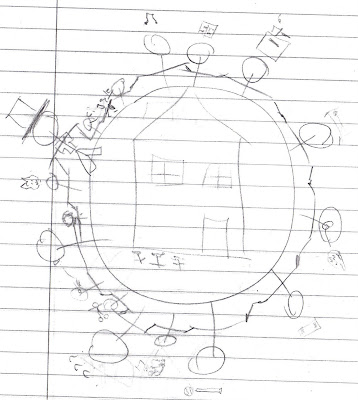
Again a home, but this time the home is encircled by a handholding collective.

This time the hand holding is central, and there are no houses at all.

Again with the hands. Common themes? Circles, people focus, hand holding, sharing, and inclusive housing. Following the community drawing, we drew to a different prompt: "What have you seen so far on the retreat?"
Again, we have some very common threads. Separation, wealth, power, and negative interaction. Clearly the world that we are traveling through is not living up to our notion of community.
There are various angles to take. Take, for instance, the government reporting document "The Current State of Homelessness," which is published every year. It frames “community” as critical to homeless care. Phrases like “community partners,” “community-sponsored,” “community-based service providers,” and “community resources” imply compassion, philanthropy, and service. Not only do important labor and resources come from the “community,” but “community” is also the place where homelessness ends. The goal of all homeless organizations it to reintegrate homeless people into the “community.”
Unfortunately, what “community” signifies is highly selective. For instance, it does not include the community homeless have among themselves. “Community” is not used to describe the collective life of those on the streets, despite the obvious communal nature of their lives. In fact, being homeless means a person is on the outside of the “community.” This is demonstrated by the common use of the term “community re-entry.” The work of homeless service is to bring homeless back into the “community.”
The following statement illustrates the separation between homeless and the community. “Pressures placed on runaway and homeless youth by law enforcement, merchant associations, and hospitality ambassadors cause them to become more invisible and drives them further into the fringes of the city” (p. 29, Arizona Homeless Coordination Office, 2009, emphasis added). Apparently, making the community feel welcome means making the homeless unwelcome. Research by Harter et al. suggests that homeless “invisibility” is a common phenomenon created through social structures (2005). Part of creating a sense of community is excluding those who threaten its predictability.
“Community” is the place where volunteers come. It can be developed through programs. Most importantly, the “community” is where people live. It may be low income, but in the end, “community” is composed of housed individuals. It is not a totally closed boundary, as some organizations provide permanent, subsidized housing, but living in a house is a precondition for participation. Unfortunately, the document excludes homeless from the community, and instead focuses on ways to end homelessness by bringing homeless back into the “community.”
So with this divisive model of community in mind, we set about trying to reconceive community in a more inclusive fashion. What better way than drawing? We drew to the prompt: "Draw community."

So we have a home, but a sign making it explicit it is open to everyone. There is also a gathering at table.

Again a home, but this time the home is encircled by a handholding collective.

This time the hand holding is central, and there are no houses at all.

Again with the hands. Common themes? Circles, people focus, hand holding, sharing, and inclusive housing. Following the community drawing, we drew to a different prompt: "What have you seen so far on the retreat?"
Again, we have some very common threads. Separation, wealth, power, and negative interaction. Clearly the world that we are traveling through is not living up to our notion of community.
Subscribe to:
Posts (Atom)